Alexander Nevsky Cathedral, Sofia: Hours, Entry, Dress Code
Alexander Nevsky Cathedral, Sofia: open daily 07:00 to 19:00, free entry, crypt icon museum €10 (€2 on Thursdays), dress code, metro and photo tips.
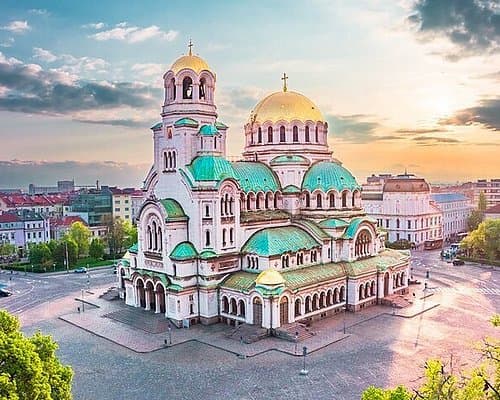

Alexander Nevsky Cathedral in Sofia is open every day from 07:00 to 19:00 and you do not need a ticket: the cathedral's own visiting page lists its hours and services and no admission charge. Only the icon museum in the crypt is ticketed, at €10 (€2 on Thursdays), Tuesday to Sunday from 10:00 to 18:00. Allow 20 to 30 minutes for the cathedral and about an hour for the crypt. If you would rather see the old centre with someone who can explain what you are looking at, Stella's Sofia, a guided walk through the historic centre with a local host on our site, costs €40 per adult and €20 per child aged 6 to 12.
In this guide12 sections
All prices are in euro: Bulgaria adopted the euro on 1 January 2026. We read the opening hours and service times on the cathedral's official website and the crypt museum's hours and prices on the National Gallery's website on 18 November 2026. Tour and transfer prices were read from our booking system the same day, and the price shown when you book is the one that counts. One note for anyone searching from abroad: this guide is about the cathedral in Sofia, Bulgaria, not the churches of the same name in Tallinn or Paris.
What Alexander Nevsky Cathedral is and why it was built
Its full name is the Patriarchal Cathedral Stauropegial Memorial Church of St Alexander Nevsky: the cathedral of the Bulgarian Patriarch and, at the same time, a memorial. Bulgaria's Constituent Assembly decided in 1879 to build a memorial church dedicated to St Alexander Nevsky, the patron saint of the Russian emperor Alexander II, known in Bulgaria as the Tsar Liberator, and a place of prayer for those who fell in the war of 1877 to 1878 that ended Ottoman rule. The foundation stone was laid on 19 February 1882, the building itself went up between 1904 and 1912 to the design of the Russian architect Alexander Pomerantsev, and it was consecrated over three days, 12 to 14 September 1924.
The numbers explain why it dominates the skyline: 72 metres long, 55 metres wide, 50.52 metres high and 3,170 square metres of floor, planned for 4,000 to 5,000 worshippers. The cathedral's own site describes it as the largest Orthodox church on the Balkan Peninsula; whichever way you measure, it is among the biggest.
Alexander Nevsky Cathedral opening hours and service times
These are the times published on the cathedral's official website:
| When | What |
|---|---|
| Every day, no closing day | Open 07:00 to 19:00 |
| Weekdays | Morning service at 08:00, evening service at 17:00 |
| Friday | Prayer service at 17:30 before the copy of the Axion Estin icon |
| Saturday and the eve of major feasts | Vigil at 18:00 |
| Sunday | Divine Liturgy starts at 09:30 |
For sightseeing, the quiet window on weekdays is roughly 10:00 to 16:30, between the morning and evening services. If you would like to hear the choir, come for the Sunday liturgy at 09:30, stand at the back and stay as long as you wish. The cathedral is busiest on its patronal feast, 23 November, and at Christmas and Easter, when the Patriarch often leads the service. You can still go in, but expect crowds and very little room to wander.
Book it with us

Entrance fee and tickets: the cathedral is free
There is no entrance fee and nothing to book. You walk in through the main doors on the west side, under the bell tower. Candles are sold at the desk just inside, and a donation is welcome but not asked for.
Photography is the one thing we could not confirm from an official source. The cathedral's website says nothing about it, and travel sites contradict each other: some say photos are banned inside, others that a paid photo permit is sold at the candle desk. So follow the signs at the door, ask at the desk before you raise a camera, and whatever the answer, do not photograph during a service or use flash. Outside, on the square, you can photograph freely.
The only ticket on the square is for the icon museum in the crypt, covered below.
Dress code and how to behave during a service
The cathedral publishes no written dress code, and nobody checks at the door. What is expected is what applies in any working Orthodox church in Bulgaria:
- Cover shoulders and knees. In summer, carry a light scarf or wear longer shorts. Beachwear is not acceptable.
- Men take their hats off. We found no rule requiring women visitors to cover their hair, and most local women do not.
- Keep your voice down and your phone silent. This is a place of prayer first and a sight second.
- During a service, stay at the back or along the sides. Do not walk in front of people who are praying, do not cross the centre of the nave, and never step beyond the low marble rail in front of the iconostasis.
- Expect to stand. Orthodox worshippers stand through the service and seats are few.
What to see inside Alexander Nevsky Cathedral
The interior is dim, tall and darker than the photographs suggest, so give your eyes a minute. Then look for these:
- The central iconostasis in white and yellow marble. Its icons were painted by four Russian artists. The two to find are Christ enthroned and the Virgin enthroned with the Child, both by Viktor Vasnetsov.
- The northern iconostasis, painted by Ivan Mrkvička, a Czech painter who was one of the founders of Sofia's State Drawing School. This altar is dedicated to Saints Cyril and Methodius.
- The royal throne, on three steps of green marble with carved lions at its sides. Above it, a mosaic shows Tsar Ferdinand and Tsaritsa Eleonora in ceremonial dress, holding a model of the cathedral.
- The Patriarch's throne, between the main iconostasis and the royal throne, under a pyramid canopy of white alabaster.
- The columns of red and green Brazilian onyx that carry the canopy over the central altar, and the Italian marbles on the walls and floor.
- The dome. Stand under it and look straight up: from the floor the single interior space reads as if it had four storeys.
Before you go in, look up at the west front: the mosaic icon of St Alexander Nevsky on the bell tower is by the Bulgarian painter Anton Mitov.
The crypt: the icon museum under the cathedral
The crypt was planned as a pantheon for distinguished Bulgarians. Today it houses the Museum of Christian Art, founded in 1965 as a branch of the National Gallery, which calls its holdings one of the richest icon collections in the world. The display runs from the 4th century, when the Roman Empire adopted Christianity, to the Bulgarian National Revival of the 18th and 19th centuries: icons, fragments of wall paintings, manuscripts and church plate. One detail most visitors miss: the cathedral's foundation stone, a block of Vitosha granite, stands in the crypt's Golden Hall.
| Crypt museum | Details from the National Gallery |
|---|---|
| Opening hours | Tuesday to Sunday, 10:00 to 18:00; ticket desk until 17:30 |
| Closed | Mondays, Bulgarian public holidays, Christmas, New Year's Day and Easter |
| Adult ticket | €10 |
| Pensioners, over 65s and students | €4 |
| Under 18s | Free |
| Every Thursday | €2 for everyone |
| Crypt and Kvadrat 500 | €18 combined |
| Guided tour in Bulgarian, English or Russian | €40, booked ahead on +359 2 981 5775 |
The crypt has its own entrance from the square: look for the museum sign to the left of the cathedral's main steps. Two practical points follow from the table. The cathedral is open on Mondays and the crypt is not, so if you want both, avoid Monday. And if your dates are flexible, Thursday saves €8 a head. Kvadrat 500, the National Gallery's main building, is directly behind the cathedral, which makes the combined ticket easy to use. For the rest of the city's museums, see our guide to the best museums in Sofia.
 Book it with us · AttractionStella's Sofia - A Journey in the Capital€40€40$44£33 / guestBook
The bells and the gold domes
The bell tower over the main entrance holds 12 bells that together weigh about 25 tonnes. The largest weighs 11,758 kg and is 2.7 metres across, the smallest weighs 10 kg, and in clear, warm weather the big bell is said to carry about 30 km. They were cast in a Russian foundry and first rang on 13 March 1913. You hear them best from the square, mostly around services and on feast days.
The gold of the central dome and the bell tower dome is what you see from half the city. It changes through the day: flat at noon, glowing in the last hour before sunset, and lit after dark.
How to get to Alexander Nevsky Cathedral
The address is simply St Alexander Nevsky Square, in the eastern part of the centre.
- Metro: the nearest station is SU Sv. Kliment Ohridski (Sofia University), on lines M1 and M4, about 5 minutes on foot from the cathedral. A ride costs €0.80 and you can tap a contactless bank card at the gate. Tickets, lines and hours are in our Sofia metro guide.
- On foot from Serdika: about 1 km and 12 to 15 minutes. Walk east along Tsar Osvoboditel Boulevard on the yellow paving, past the former royal palace and the Russian Church, and turn left when you see the domes.
- From the airport, or on a layover: line M4 runs from Terminal 2 straight to SU Sv. Kliment Ohridski with no change, in about 20 minutes. With five hours or more between flights, that is enough for the cathedral, the square and a coffee. Terminal 1 has no metro station; how to get between the terminals is in our Sofia Airport guide. With luggage, children or a late arrival, a private transfer from Sofia Airport to the city centre booked on our site starts from €30 per car.
- By car: the cathedral sits inside the city's paid parking zone, and spaces nearby are scarce. Come by metro if you can.
Want to wake up next to it? Sense Hotel Sofia, on Tsar Osvoboditel Boulevard, is a few minutes' walk from the cathedral. For other areas, see all our hotels in Sofia.
What is around the square
The cathedral is the centre of a compact group of sights, all within five minutes' walk:
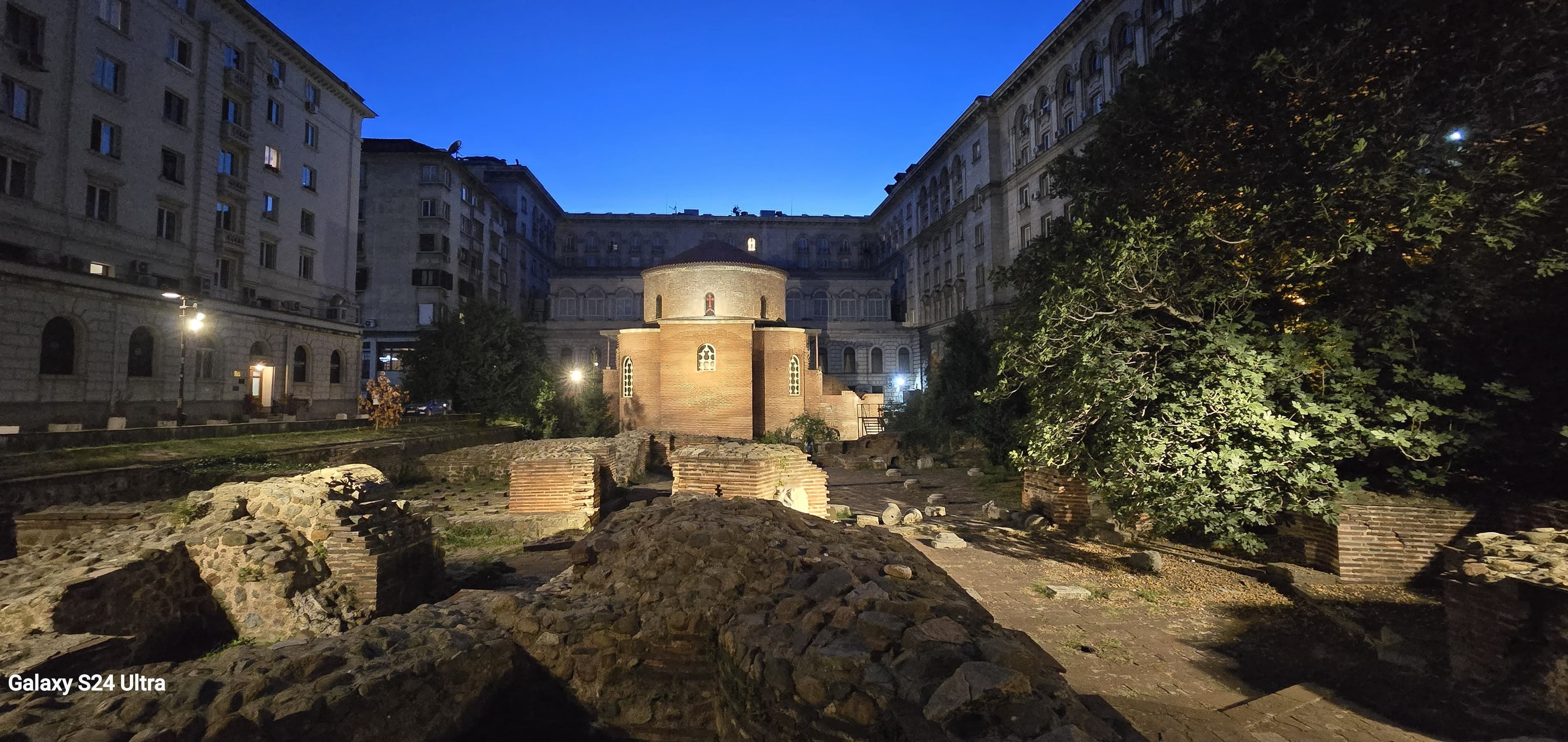
- St Sofia Church, about 150 metres to the west: the red brick basilica that gave the city its name, with the Monument to the Unknown Soldier and its eternal flame beside it.
- The antiques and souvenir stalls that usually set up in the small garden by the square: old cameras, medals, embroidery and painted icons. Be careful with anything sold as a genuine antique or an old icon. Taking cultural valuables out of Bulgaria requires documents, so buy new, clearly modern pieces unless the seller can provide the paperwork.
- The National Assembly and the mounted statue of the Tsar Liberator, just south of the cathedral on Tsar Osvoboditel Boulevard.
- The Russian Church of St Nicholas, small, with green tiles and gilded onion domes, a few minutes further along the same boulevard towards Serdika.
- Kvadrat 500, the National Gallery, directly behind the cathedral on 19 Fevruari Street.
- The Monument of Salvation, in the garden between the National Assembly and Sofia University. Its story is in our Jewish Sofia guide.
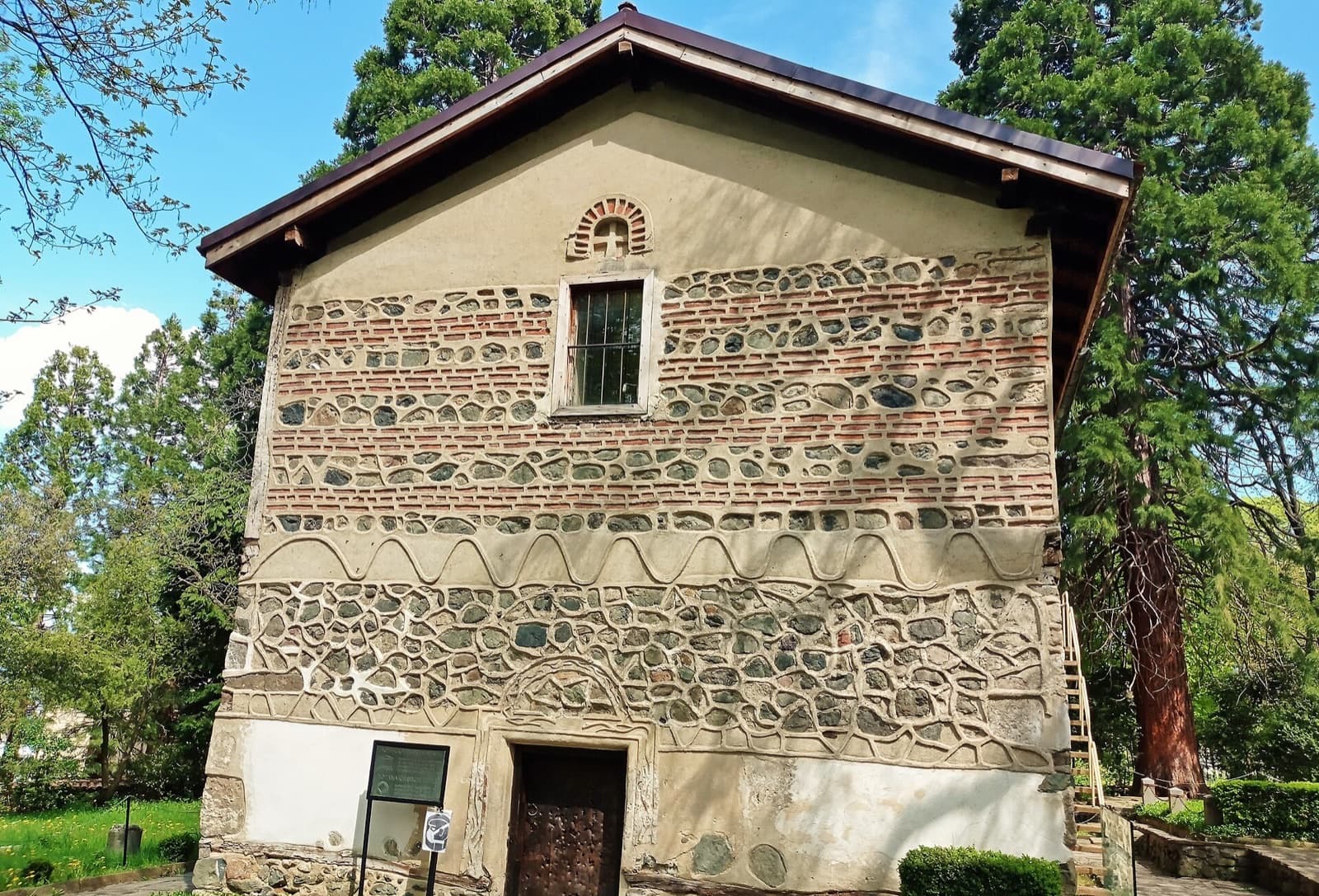
How the cathedral fits into a full day in the centre is laid out in our 3 days in Sofia itinerary, and the rest of the city is in the Sofia guide. If churches are your thing, the medieval frescoes of Boyana Church, on the edge of the city, are the natural second stop.
How long a visit takes and the best time for photos
Plan 20 to 30 minutes inside the cathedral, 45 to 60 minutes for the crypt, and another half hour to walk around the outside and over to St Sofia. An hour and a half covers everything without rushing.
For photographs, the direction of the building matters. The main entrance and bell tower face west, so the front is in shade in the morning and lit in the afternoon. The best light on the facade and the gold domes is the last hour before sunset, which in December means from about 16:00. In the morning, walk round to the east side, by the National Gallery, where the stacked half domes catch the early sun. For the whole building in one frame, stand back on the west side of the square, towards St Sofia. After dark the cathedral is floodlit.
Seeing the cathedral with a guide
A church this size is easier to read with someone explaining it. Two walks are sold on our site, each run by its own host:
- Stella's Sofia: 2 to 4 hours through the layers of the old centre, from the Roman ruins past Ottoman mosques and medieval churches, with guiding in English, Bulgarian or Russian. €40 per adult, €20 per child aged 6 to 12, under 6s free. The listing does not name each stop, so if you want time inside the cathedral, tell the host when you book.
- The Sofia small-group walking tour: up to two hours, €18 per adult, in English, Bulgarian or Greek, for groups of up to 20. It meets at 1, 19 Fevruari Street, the street directly behind the cathedral, and the listing shows the gold domes as one of its five stops. It does not say whether the group goes inside, so ask the host.
Neither listing includes the crypt ticket, so buy that yourself at the museum desk. More options, from food walks to day trips, are on the page of all experiences in Sofia.
How to book
- Choose your walk. Stella's Sofia at €40 per adult and €20 per child aged 6 to 12 is the fuller option, at 2 to 4 hours. The small-group walking tour at €18 is the short one, and it starts behind the cathedral.
- Book ahead. Stella's listing asks for at least 6 hours' notice and the small-group tour for 48 hours, and the host confirms every request. For weekends and for the second half of December, book a few days earlier.
- Pay 20% online. The rest is paid to the host at the end of the tour.
Arriving by air? You can book the private transfer from Sofia Airport to the centre at the same time, from €30 per car for up to 4 passengers. The price is confirmed on the booking page.