Bansko Weather by Month: Snow, Ski Season and Summer
Bansko weather by month: town vs ski area temperatures, when the snow comes, how warm August gets, and how to get there with no airport in Bansko.

Bansko weather depends above all on altitude. The town sits at about 925 metres, while the ski area above it climbs to about 2,600 metres, where it is usually several degrees colder, often up to about 10°C. In town, January is the coldest month, averaging 3°C by day and -6°C at night, and July and August are warm and pleasant at 27°C by day and 12 to 13°C at night. Snow on the mountain usually lasts from December to April, and the ski season typically opens in mid December and closes in mid April. One more thing to know before you book: Bansko has no airport. You fly into Sofia and drive about two hours.
In this guide10 sections
Below you will find a month by month table, the difference between the town and the slopes, what to expect in December and in August, and how to check today's conditions before you head out.
Bansko weather by month
The figures were measured in the town itself: temperatures are 2000 to 2014 averages of the daytime high and the night-time low, and monthly precipitation is the long term average for 1931 to 1970. The last column describes what is happening on the mountain and in the ski area that month.
| Month | Day high (°C) | Night low (°C) | Precipitation (mm) | On the mountain |
|---|---|---|---|---|
| January | 3 | -6 | 71 | Peak ski season. The coldest month, and up to about 10°C colder at the top than in town |
| February | 6 | -4 | 59 | Full winter. Snow cover peaks at 40 to 60 cm between 1,000 and 1,800 m |
| March | 10 | -1 | 52 | The deepest snow of the year: 160 to 180 cm above 1,800 m, with longer days |
| April | 16 | 4 | 56 | The ski season usually ends mid month. Spring has arrived in town |
| May | 21 | 8 | 65 | Snow still lingers on high trails. Green and fairly wet in town |
| June | 24 | 11 | 57 | Hiking season begins. In summer 2026 the gondola ran daily from 27 June |
| July | 27 | 13 | 42 | Around 15°C on average at 2,000 m. Thunderstorms around midday and after |
| August | 27 | 12 | 31 | The driest month in town, and a good time for the lakes and peaks |
| September | 23 | 9 | 37 | Crisp mornings up high. From 7 September the gondola runs on weekdays only |
| October | 17 | 5 | 65 | Mild days and cold nights. A quiet month between seasons |
| November | 11 | 2 | 79 | One of the wettest months. The first lasting snow depends on cold spells |
| December | 5 | -4 | 80 | The wettest month. The ski season usually opens mid month, snow permitting |
Averages hide the extremes: single days can be far warmer or colder. The records measured in Bansko between 1926 and 1970 are 36.5°C in August and -24.8°C in January.
Bansko ski resort weather vs the town
The gondola climbs from town to Banderishka Polyana, the main ski base at around 1,600 metres, and the lifts continue to about 2,600 metres on the shoulder of Todorka peak. A meteorologist's rule of thumb is that temperature drops by about 0.65°C for every 100 metres you climb. By that rule the top of the lifts can be around 10°C colder than the main street, before you add the wind.
In practice that means two things. In winter, a -2°C morning in town can be roughly -12°C at the top, so layers, gloves and a neck warmer are essential, for children too. In summer, on a 27°C day in town, you will want long sleeves and a windproof jacket in your pack at the lakes and at Vihren hut. Snow differs just as much: at lower altitudes 70 to 90 percent of winter precipitation falls as snow, and higher up almost all of it does. That is why the mountain can be white while it rains in town.
Bansko weather in December and through the winter
December in town averages 5°C by day and -4°C at night, and it is the wettest month of the year. At town level rain and snow alternate, so in early December the streets can be grey and bare even when the peaks are already white. January is the coldest month, while February and March bring the most snow on the mountain.
The Bansko ski season usually runs from mid December to mid April. Last winter it opened on 13 December 2025 and was scheduled to run until 12 April 2026. As of 8 October 2026 the ski area had not published an opening date for 2026/27, which depends on snow and cold. For what is open, the pistes and how to plan your trip, see our guide to skiing in Bansko. If you just want to see snow without skiing, our guide to snow in Bulgaria has the options.
Coming with children or skiing for the first time? Our guided ski lessons in Bansko last up to two hours, a length that also suits the cold January mornings.
On mornings like that the walk to the gondola matters too: the Kempinski Hotel Grand Arena Bansko stands right across from the gondola station, so the day starts on the snow rather than with a walk in the cold.
Bansko in summer: how warm is August?
Bansko in summer is warm rather than hot. July and August average 27°C by day and drop to 12 or 13°C at night, and August is the driest month of the year with only 31 mm. If you come from a hot city, you will notice it on your first evening: bring a sweater for dinner outdoors.
Higher up it is another story. At 2,000 metres the July average is around 15°C, and the peaks are windy. Summer thunderstorms in the Bulgarian mountains tend to build around midday and in the afternoon, and the Mountain Rescue Service warns about them regularly. Start early and finish the high part of any route by midday.
The Bansko activities that depend most on the weather, from easy to hard:
- Riding: horse riding in Bansko on forest trails, an easy outing that suits families.
- Buggy: the UTV buggy mountain safari in Bansko follows forest tracks in Pirin to some of the best viewpoints around Bansko. On a hazy day you see less, so pick a clear one.
- Rafting: rafting on the Struma River. According to the guides, spring brings high water and full gear, while in summer the water is warm and there is time for a swim.
- Summit: the Vihren peak hike takes you to 2,914 metres, the highest point in Pirin, on a 7 to 8 hour day that passes clear mountain lakes on the way. Check the forecast the evening before.
A tip for hot days: the gondola lifts you from town to Banderishka Polyana, about 700 metres higher and a few degrees cooler. In summer 2026 it ran daily from 27 June to 6 September, 8:00 to 16:30. For everything else to do in Bansko in summer, from the old town to the hot springs, see our complete Bansko guide.
Bansko in September and October
September is a very comfortable month for hiking: 23°C by day, 9°C at night and little rain. In October it drops to 17°C by day and 5°C at night, and the rain returns. Mind the gondola: from 7 September to the end of November it runs on weekdays only and in one direction, up at 8:00 and down at 16:30, so if you ride it you spend the whole day up there. For ideas for this season, read our guide to Bulgaria in autumn.
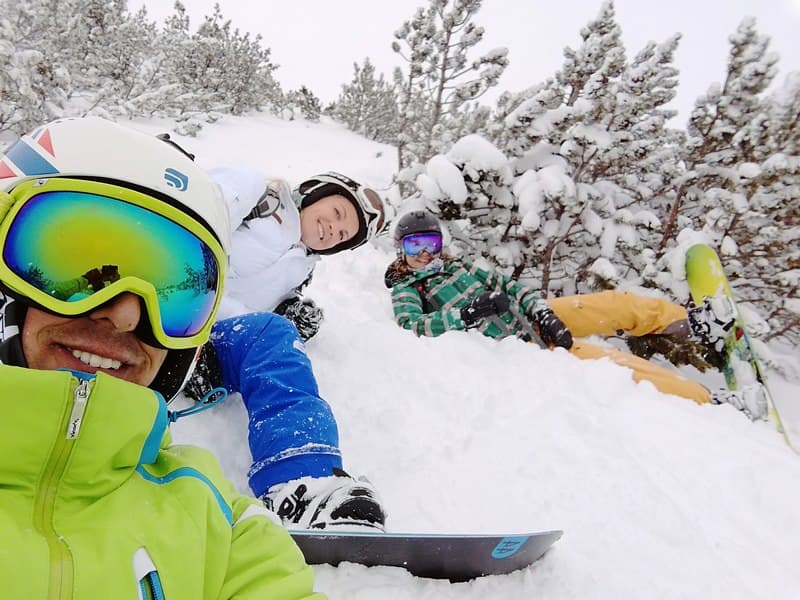 Book it with us · AttractionGuided Ski lessons - 2 hoursFrom€145€145$162£123Book
Spring in Bansko: March to May
Spring gives Bansko two seasons at once. In town April reaches 16°C by day and May 21°C, but snow stays on the mountain much longer: in March there are 160 to 180 cm above 1,800 metres, and on 21 May 2026 the Mountain Rescue Service was still warning about lingering snow in the high mountains. It is a lovely time for walks in town and the valley. For summit treks, wait for summer.
Is there an airport in Bansko?
No. The nearest airport is Sofia, about 158 km away, roughly 2 hours 10 minutes by road and a little longer in snow. The last part of the route crosses the mountains and can be snowy in January and February. The easiest option is a private transfer from Sofia Airport to Bansko, from €159 per car for up to 4 passengers, with the driver waiting in the terminal with a name sign. From Sofia city the transfer starts at €156 per car and takes about two hours. Route, luggage and timing details are in our Sofia to Bansko transfer guide.
Bansko weather today: forecast and webcams
A two week forecast is only a rough direction. A few days before you travel, check the forecast for the coming days, and on the morning itself look at the webcams. The ski area runs live webcams in town, at Banderishka Polyana, Plato and Todorka, plus a forecast and snow depth page. Comparing the town camera with the Todorka camera quickly shows whether there is snow up high even when there is none in town.
What to pack for Bansko by season
- Winter: a warm jacket, a thermal base layer, gloves, a hat, a neck warmer and sunglasses. The sun on snow is strong even when it is cold.
- Summer: light clothes for town, a sweater for the evening, a windproof jacket and hiking shoes for the mountain, a hat and sunscreen.
- Spring and autumn: layers and a rain jacket. Mornings are cold and afternoons mild.
The bottom line
Bansko always has two climates: one in town and one on the mountain. For skiing, come between mid December and mid April, with February and March bringing the most snow. For hiking, come from July to September and start early. Whatever the season, pack for the altitude, not for the town.
Share this guide