Jewish Sofia: Sofia Synagogue Hours and the Rescue Story
Jewish Sofia: Sofia Synagogue opening hours, the €10 ticket and what to see inside, the old quarter, the 1943 rescue and deportations, memorials and tours.
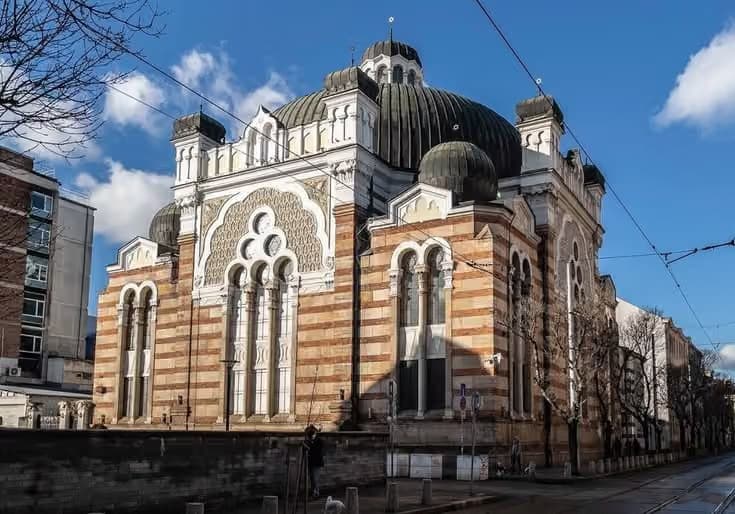
Jewish Sofia starts at the Sofia Synagogue, 16 Exarch Yosif Street, a few minutes' walk from Serdika metro station and right across from the Central Market Hall. According to the synagogue's own website, it is open to visitors Sunday to Friday from 09:00 to 17:00, closed on Saturdays, Jewish holidays and Bulgarian public holidays, and a ticket costs €10, including "The Niche" exhibition on the heritage of Bulgarian Jews and an audio guide. Around it lies the rest of the story: the old Jewish quarter, the memorials to the rescue of about 48,000 Bulgarian Jews in 1943, and the memory of more than 11,000 Jews from the Bulgarian occupied territories who were deported that same spring and never came back. If you would rather hear it from a guide, join our Jewish Sofia walking tour of the old quarter and the rescue story, 2 to 4 hours, €45 per adult.
In this guide11 sections
All prices are in euro: Bulgaria adopted the euro on 1 January 2026. Synagogue hours and ticket prices were read from its official website on 18 October 2026, and our tour and transfer prices from our booking system the same day. The price shown when you book is the one that counts.
Sofia Synagogue opening hours, tickets and address
The Central Sofia Synagogue is a working Sephardic synagogue and the largest on the Balkan Peninsula. These are the practical details, as published on its official website:
| What | Details |
|---|---|
| Address | 16 Exarch Yosif Street, central Sofia, next to the Central Market Hall and the Banya Bashi Mosque |
| Visiting hours | Sunday to Friday, 09:00 to 17:00 |
| Closed | Saturdays, Jewish holidays and Bulgarian public holidays |
| Adult ticket | €10 |
| Students and seniors | €8 |
| Groups of 10 | €6 per person |
| Included | "The Niche" exhibition, a personal audio guide and permission to take photos |
| Payment | Cards accepted |
| Office phone | +359 2 983 12 73 |
Two things to know before you go. First, Fridays: some websites still list shorter Friday hours, so if you plan a Friday afternoon visit, call or email the office first. Second, if you want to attend a service rather than visit, the synagogue asks you to contact its office at least three days in advance.
Inside the Sofia Synagogue: what to look for
The synagogue was inaugurated on 9 September 1909 in the presence of Tsar Ferdinand, built in four years to a design by the Viennese architect Friedrich Grünanger. The style is Spanish Moorish with touches of the Vienna Secession, and the facade mixes Moorish and Venetian elements. Inside, look out for these details:
- The chandelier: cast in brass in Vienna to Grünanger's design, it weighs 1,700 kg and is ringed with around 400 Stars of David. Each circle of lamps holds eight lights, a nod to the eight days of Hanukkah.
- The dome: the octagonal prayer hall was built for 1,170 worshippers, and the dome rises 23 m above it on the inside. The ceiling is painted to suggest the heavens, and no human figure appears anywhere in the building.
- The foundations: according to the synagogue, tombstones from an old Jewish cemetery were built into the base of the building.
- The bomb that did not explode: on 13 April 1944, during the bombing of Sofia, a bomb fell on the northeastern corner and failed to go off. The blast shook out the stained glass windows, and a stained glass panel above the balcony now recalls the day.
- The refusal of 1982: under communism the Ministry of Culture tried to turn the synagogue into a concert hall, and the community's leaders refused.
Since February 2026 the synagogue has hosted "The Niche", an exhibition of religious objects and personal items that tell the story of the community and its place in Bulgarian history. The audio guide has 18 stories in six languages, including English, German, French and Spanish. There is no app to download: you scan a code on site and listen on your phone, so bring it charged, and headphones if you have them. Allow about an hour for the building and the exhibition.
Visiting rules: dress, Saturdays and services
- Dress: this is a working house of prayer. The official website does not publish a dress code, but modest clothing with shoulders and knees covered is the simple choice, and it is what the host of our tour asks of every guest.
- ID: the official website does not mention a security check or ID at the door. Our tour host asks guests to bring valid ID, so carry it.
- Saturdays and holidays: the synagogue is closed to visitors on Saturdays. A weekday morning, Friday or Sunday, is the safe choice.
- Services: daily prayers take place in a small prayer room to the right of the entrance; the great hall is used mainly on major holidays and for events. To join, contact the office three days ahead.
- Photos: permission to take photos is included in the ticket.
The Jewish quarter of Sofia: Yuchbunar and what is left
Sofia's historic Jewish quarter was Yuchbunar, west of the synagogue and the market, in today's Vazrazhdane district. Before the war it was home mostly to the city's poorer Jewish families, with small synagogues, schools and shops, while better off families lived along what is now Maria Luiza Boulevard. In 1934 about 25,000 Jews lived in Sofia, some 9% of the capital's population.
To be honest, there is very little of the quarter itself left to see. The small synagogues are gone and most houses have been rebuilt. What remains is the map: the great synagogue, the market hall opposite, and Vazrazhdane Square, where a rescue memorial now stands. This is where a guide makes the difference, pointing out where a school stood or which street families were expelled from in 1943.
Bulgarian Jews in the Second World War
In March 1941 Bulgaria allied itself with Nazi Germany, and in April 1941, after the German attack on Yugoslavia and Greece, it was allowed to occupy most of Greek Thrace, Yugoslav Macedonia and the Pirot area. In January 1941 the "Law for the Protection of the Nation" had already been passed, an anti Jewish law modelled on the Nuremberg Laws: Jews were pushed out of public service and many professions, restricted in where they could live, and barred from marrying non Jews. Jewish men were sent to forced labour camps around the country, and from mid 1942 Jews had to wear the yellow star. Families in Sofia were forced into Yuchbunar.
In spring 1942 Germany asked Bulgaria to hand over the Jews in the territories it controlled, and Bulgaria agreed. A Commissariat for Jewish Affairs was set up in the Interior Ministry, and by winter 1943 a first deportation of 20,000 Jews had been agreed with Adolf Eichmann's office.
Thrace and Macedonia: the 11,343 who were not saved
This has to be said before the rescue story. In the first half of March 1943 the Bulgarian authorities deported 11,343 Jews from the territories Bulgaria occupied: Thrace, Macedonia and Pirot. German authorities took them to the Treblinka killing centre, where virtually all of them were murdered. Sofia's main memorial names them explicitly, and so do we.
The rescue of the Bulgarian Jews: March and May 1943
In the same days the first deportation from Bulgaria proper was being prepared. On 9 March 1943 a delegation from Kyustendil, the home town of Dimitar Peshev, deputy speaker of parliament, came to him in Sofia, and that same day Peshev and a few fellow deputies went to the Interior Minister and demanded that the order be cancelled. The deportation was postponed. On 17 March Peshev wrote a letter of protest, signed according to Yad Vashem by 42 members of parliament (some sources count 43). The ruling majority rejected it, and Peshev was forced out of his post at the end of March.
Alongside the deputies stood leaders of the Bulgarian Orthodox Church, above all Metropolitan Stefan of Sofia and Metropolitan Kiril of Plovdiv, as well as public figures and ordinary citizens. On 24 May 1943 the plan to deport Bulgaria's 48,000 Jews was revoked, and the Jews of Bulgaria survived the war. The rescue did not end the persecution, though: in May 1943 nearly 20,000 Jews were expelled from Sofia to provincial towns, most of their property was confiscated, and the men were sent to forced labour.
Yad Vashem recognised Dimitar Peshev as Righteous Among the Nations in 1973, and Metropolitans Stefan and Kiril in 2001. After the war most of the community emigrated: by 1948 more than 35,000 Bulgarian Jews had left the country.
 Book it with us · AttractionJourney in Sofia: The Jewish Quarter and the Story of RescueFrom€45€45$51£38Book
Dimitar Peshev and the rescue memorials in Sofia
These are the places in Sofia that mark the rescue, all within walking distance of the centre:
- The Monument of Salvation: in St Kliment Ohridski Garden, between the National Assembly, the National Academy of Arts and Sofia University, not far from the Alexander Nevsky Cathedral. Unveiled in 2016, it shows a man and a woman in an embrace with a Star of David between them. The plaque beside it says that in the spring of 1943 the deportation of more than 48,000 Bulgarian Jews was prevented, and in the same text it remembers the more than 11,000 Jews from Northern Greece and parts of Yugoslavia who were deported and murdered at Treblinka. The official ceremony is held here every 10 March.
- The memorial plaques by St Sofia Church: three plaques on Moskovska Street, the oldest memorials of their kind in Sofia, in three languages. They honour Dimitar Peshev, Metropolitan Stefan, Tsar Boris III and Tsaritsa Ioanna. The plaque to the tsar remains contested, because his government carried out the deportations from Thrace and Macedonia.
- The Monument to the Lawyers who Rescued the Bulgarian Jews: on Vazrazhdane Square, in the area of the old Jewish quarter. Unveiled in November 2023, it honours the lawyers who helped in the rescue: a bronze Star of David seen from above, with mirrors inside and an inscription that lights up at night.
- The Dimitar Peshev House Museum in Kyustendil: the house where Peshev was born, in Kyustendil in southwest Bulgaria, has been a museum since 2002. That is a day out of Sofia, and opening hours should be checked with the municipality before you set off.
From the synagogue to the Monument of Salvation and the plaques is roughly a 15 to 20 minute walk east, and from there the Alexander Nevsky Cathedral is a natural next stop.
The Jewish community of Sofia today
Sofia's Jewish community is small but active. It is represented by the Organization of the Jews in Bulgaria "Shalom", which works to preserve Jewish identity, traditions and heritage, including synagogues, cemeteries and monuments, and campaigns against antisemitism. Its offices and the Beit Ha'am community centre are on Alexander Stamboliyski Boulevard in the city centre.
Hanukkah and 10 March: dates to know in Sofia
Hanukkah 2026 begins on the evening of 4 December and runs until 12 December. In recent years the Central Synagogue has held an official candle lighting with state leaders: in December 2024, for example, the sixth candle was lit there in the presence of the Speaker of Parliament and the Vice President. We found no official announcement of a public menorah lighting in a Sofia square, and nothing has yet been published about the 2026 ceremony, so if you are in town for Hanukkah, contact the synagogue office before you travel and ask whether it is open to visitors and whether any lighting is open to the public. December in Sofia has much more to offer, from Christmas markets to snow days, all in our guide to Bulgaria in winter.
10 March is the Day of the Rescue of the Bulgarian Jews and of remembrance of the victims of the Holocaust. Flowers are laid every year at the Monument of Salvation in St Kliment Ohridski Garden, and in March 2026 the 83rd anniversary was marked there with Bulgaria's foreign minister.
A Jewish heritage tour in Sofia: guided or on your own
You can do the whole route on your own with the synagogue's audio guide and this page in hand. But the Jewish quarter, where almost nothing is left, is best seen with someone who can tell its story. Our walking tour of Jewish Sofia and the rescue story, linked above, is guided in English, Bulgarian and Russian, among other languages:
- What it covers: the former Jewish quarter, its synagogues, the antisemitic laws, the Holocaust years and the rescue.
- How long: 2 to 4 hours, about three hours on foot, at an unhurried pace.
- Price: €45 per adult, €22 for children aged 3 to 12.
- Not included: the synagogue ticket, €10 at the door.
- Meeting point: the city centre; the exact address is sent after you book.
- Booking and payment: book at least 24 hours ahead; you pay 20% online and the rest to your host at the end of the tour. The cancellation terms are on the tour page.
A self guided morning, on a weekday: the synagogue and the exhibition for about an hour, across the street to the Central Market Hall, west on foot to Vazrazhdane Square and the lawyers' memorial, then back east to the plaques by St Sofia Church and the Monument of Salvation. Allow three to four hours at a relaxed pace.
Fitting Jewish Sofia into your trip
The synagogue sits in the heart of the centre, so it fits easily into your first day. From the airport, a private transfer from Sofia Airport to the city centre starts at €30 per car for up to 4 passengers. To stay within walking distance, the Sofia Balkan Palace on Sveta Nedelya Square is about five minutes away on foot. For the rest of the city, from the cathedral to Vitosha, see our Sofia in 3 days itinerary.
Heading on to Plovdiv? Metropolitan Kiril opposed the deportation of the city's Jews there, and our Plovdiv guide covers the old town.
The bottom line
Jewish Sofia is not a preserved quarter of picturesque lanes. It is one remarkable synagogue, a few memorials in gardens and squares, and a complex story worth hearing in full: both the rescue of the Bulgarian Jews and the 11,343 Jews deported from the territories Bulgaria held. Plan your visit for a weekday, check the hours with the synagogue before a Friday or a holiday, and if you want someone to connect the places into one story, take a guided tour.
Share this guide