
Plovdiv: The Complete Guide to Europe's Oldest Continuously Inhabited City
The complete guide to Plovdiv, Europe's oldest continuously inhabited city: Roman Theater, Old Town, Kapana district, day trips from Sofia, and real tips.
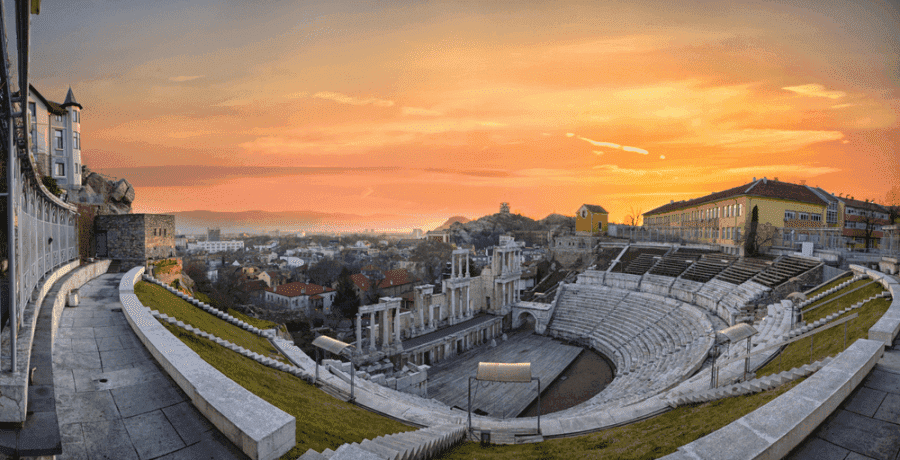

Plovdiv is a secret most visitors haven't discovered enough yet. It's Europe's oldest continuously inhabited city (and 6th in the world), with 8,000 years of history, a Roman theater still hosting concerts nearly 2,000 years after it was built, and an arts district that rose from a neglected neighborhood to become one of the Balkans' most interesting. Anyone who comes to Bulgaria without giving Plovdiv two days misses one of the most beautiful cities in Eastern Europe. This guide sorts it out.
В това ръководство12 раздела
Important note: As of January 1, 2026, Bulgaria officially adopted the euro. All prices in Plovdiv are now in euros, and some businesses still display leva (лв) alongside euros during the transition period. Credit cards work almost everywhere, but at small restaurants in the Old Town, keep some cash on hand.
Table of Contents
- Why Plovdiv Deserves a Day or Two
- The Old Town: Plovdiv's Heart
- The Ancient Roman Theater
- Kapana District: The Modern Side
- Other Sights Worth Seeing
- Day Trips from Sofia to Plovdiv
- Where to Eat and What to Taste
- Getting There and Around
- When to Go
- FAQ
Why Plovdiv Deserves a Day or Two
Plovdiv is Bulgaria's second-largest city (about 350,000 residents), located two hours' drive from Sofia. But the real impressive figure is historical: Plovdiv has been continuously inhabited for 8,000 years, making it the oldest continuously inhabited city in Europe, and sixth in the world after Jericho, Byblos, Damascus, Susa, and Shahr-e Sukhteh.
Like Rome, Plovdiv is built on 7 hills. The Thracians built an ancient city here before the Romans. The Romans turned it into a trading hub with an impressive theater. The Byzantines added a layer. The Ottomans added mosques. In the 19th century, Bulgarian merchants built the famous National Revival houses. In 2019, Plovdiv was the European Capital of Culture. Everything is there: layers upon layers upon layers.
What makes Plovdiv special: it's classic without being clichéd. Cultural without being pretentious. Authentic without being neglected. And it's cheap, even cheaper than Sofia. A meal at a good Old Town restaurant runs €15 to €25 per person.
The Old Town: Plovdiv's Heart
If you're only in Plovdiv for one day, spend it in the Old Town. We're talking about an hour's climb through cobblestone alleys, among 19th-century wooden houses that look like paintings for an art exhibition, with a dreamy view of the city and the Rhodope Mountains on the horizon.
Bulgarian National Revival Style: What You're Seeing
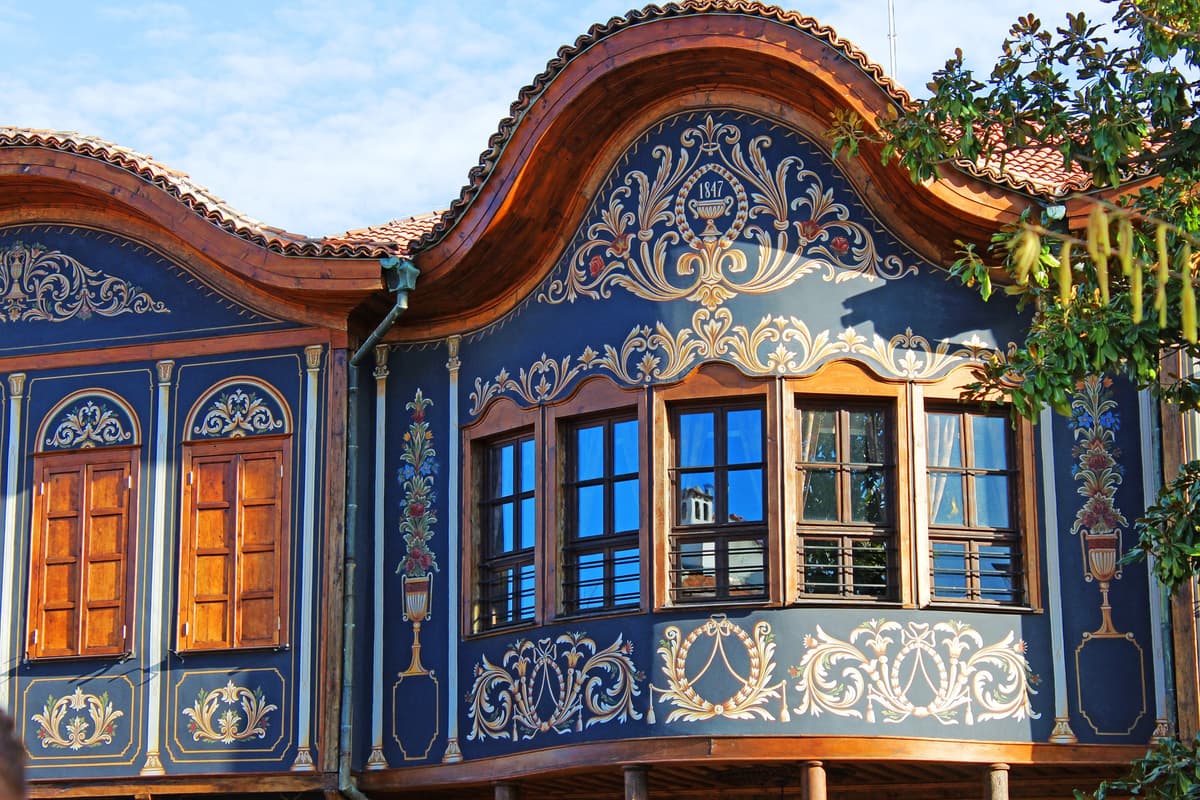
The colorful houses you'll see in the Old Town aren't just pretty: they're evidence of a specific period in Bulgarian history. This is the Bulgarian National Revival style (1760 to 1878), a period when Bulgaria was still under Ottoman rule, but the Bulgarian merchant class was accumulating wealth and beginning to express national identity through architecture.
The classic features: narrow stone ground floor, wider second floor protruding over the street, facades painted with floral ornaments, carved wooden ceilings, special windows with "kyoshk" (bay windows). The house in the photo above, with the date "1847," is a classic example.
Must-Visit Houses
- Kuyumdzhiev House (Ethnographic Museum): One of the most beautiful houses, today a museum of Bulgarian ethnography. Entry about 8 BGN / €4.
- Balabanov House: A massive merchant's house, beautifully restored, with an inner courtyard and original furniture.
- Hindliyan House: An Armenian-Bulgarian merchant's house, famous for its stunning interior wall paintings.
- Lamartine House: Named for the French poet who stayed there in 1833.
Other Old Town Sights
Hisar Kapia: An ancient Roman gate from the 2nd century CE that's still standing, part of the Old Town walls.
Nebet Tepe: The northern hill, site of the ancient Thracian settlement and later Roman fortress. From this viewpoint you get an amazing panoramic view of Plovdiv, best for sunset photos.
Saints Constantine and Helena Church: A beautiful 19th-century church with internal frescoes.
The Ancient Roman Theater
This is the most famous place in Plovdiv, and not by accident. Plovdiv's Roman Theater (Philippopolis at the time) was built during the reign of Emperor Trajan in the 1st century CE, and is considered one of the best-preserved Roman theaters in the world.
The amazing story: the theater was completely buried in earth and buildings for 1,600 years. Only in 1970, after a rockslide, was it accidentally discovered. Archaeologists excavated 4.5 meters of earth to expose it, and the use of the "anastylosis" method (rebuilding from original stones) earned the project international recognition.
The structure: a semicircular arc with a capacity of 5,000 to 7,000 spectators, 28 rows of marble seats. On some of the seats, the names of the city's districts are still carved, so residents knew exactly where to sit.
Most importantly, the theater is still active. In summer, opera performances, concerts, and ceremonies take place there. If you're there at the right time, watching a performance in a 2,000-year-old theater with a view of the city: that's an experience you won't forget. Regular festivals: "Opera Open" Festival, International Folklore Festival, "Sounds of Ages" Rock Festival.
Entry: about 10 BGN / €5. The recommendation: arrive in early morning hours to avoid the midday heat, or toward sunset when golden light makes the white stone look magnificent.
Kapana District: The Modern Side
If the Old Town is Plovdiv's history, Kapana ("the Trap" in Bulgarian) is its present. This is a small district of a few cobblestone streets, north of the main Alexander Street, that was neglected for decades, until 2014 when a project to turn it into an arts and culture center began.
Today Kapana is a blend of art galleries, local workshops, small cafés, bars with local beer, massive street-art murals on old buildings, and festivals every summer. This is the place to see the young, creative, modern side of Bulgaria.
What to Do in Kapana
Morning: Coffee at one of the local boutique cafés: try Cat & Mouse or Monkey House.
Noon: A meal at one of the district's bars. Prices are reasonable (€10 to €20 per person) and the atmosphere is bohemian.
Afternoon: Tour the art galleries. Most galleries are free entry.
Evening: Local beer at one of the bars. The Kapana scene peaks in the evening, with live music and street food.
Other Sights Worth Seeing
Dzhumaya Mosque
A 15th-century mosque from the Ottoman period, still active. Located on Plovdiv's main street, it's a beautiful example of Ottoman architecture in the Balkans. Logistics: quiet, no entry fee, open if you dress modestly.
The Roman Stadium
Beneath Plovdiv's main street hides another Roman wonder: the remains of Philippopolis's Roman Stadium, which at its time held about 30,000 spectators. Only a small portion is visible today, at the entrance to Alexander Street. Worth a 10-minute stop.
Thracian Tombs at the Archaeological Museum
Plovdiv's Archaeological Museum holds one of the largest collections of Thracian artifacts in the world, including stunning Roman mosaics. Half an hour to an hour's visit.
Vintage Car Museum
Plovdiv's Vintage Car Museum is a unique attraction, with a collection of rare classic cars. It's the perfect trip for families with teenagers interested in cars, or for enthusiasts of industrial design history. Price: €96 per person (€50 per person from the third guest, children included), about 8.5 hours, includes transfer from Sofia.
 Резервирайте при нас · ОбиколкаПътуване до Пловдив в стил стара градска част и колекционерски автомобилиОт€96€96$107£80Резервирайте
Day Trips from Sofia to Plovdiv
Most visitors who come to Bulgaria spend most of their time in Sofia, and arrive in Plovdiv as a day trip. This is a good option, but it's important to know you can't "do" Plovdiv in two hours. The city requires at least 6 to 7 hours on site to taste all its layers.
Guided Day Trip to Plovdiv
The Plovdiv day trip from Sofia is the most recommended option. Professional guide, comfortable 2-hour drive from Sofia, guided walking tour of the Old Town and main sites, and free time in the Kapana district. Total 8 hours from Sofia. Price: €105 per person (€60 per person from the third guest, children included). This is the recommended tour if it's your first time in Plovdiv.
Vintage Car Museum Day Trip
An interesting alternative for those who've already been to Plovdiv once, or looking for something different: the Vintage Car Museum day trip from Sofia. Includes both the museum visit and time in the city. Especially suited for families with teenagers or car enthusiasts. Price: €96 per person (€50 per person from the third guest, children included), 8.5 hours.
Where to Eat and What to Taste
Plovdiv is a serious food city, both because of the history (Bulgarian, Turkish, Greek, Armenian cuisine) and because of the new restaurant scene that grew up around the 2019 European Capital of Culture title.
In the Old Town
Hebros: A restaurant in a restored 1850 Revival house. Traditional Bulgarian food in a setting you won't find anywhere else. Expensive relative to Bulgaria (€30 to €40 per person) but worth the experience.
Philippopolis: View of the Roman Theater, international food with a traditional lean. Perfect for evening.
Hemingway: A café-restaurant with classic atmosphere, good for breakfast or lunch.
In Kapana
Pavaj: A brewery restaurant with pizzas and fresh vegetables. Reasonable prices.
Monkey House: A café-bar with bohemian atmosphere, light and good food.
Bar Petnoto: Local beer and dairy food. Good for evening.
Must-Try Dishes
- Sarma: Stuffed grape leaves with rice and meat, a traditional dish of the region.
- Apricot jam: Local apricot jam, Plovdiv is famous for its apricots.
- Bulgarian hummus (try Café Hummus Ramon in Kapana).
- Apple rakia: The region is famous for apple rakia, as opposed to the plum of the rest of Bulgaria.
Getting There and Around
From Sofia to Plovdiv
Bus: The easiest option in both directions. Buses leave every hour from Sofia's central station, the ride is about 2 hours, price: €7 to €10 one way.
Train: Slower (2.5 to 3 hours), less comfortable, but a scenic experience.
Private transfer: If you're with kids, a group, or want maximum flexibility, book a private transfer.
Organized tour: The most convenient option. Our guided tour from Sofia includes everything: drive, guide, site visits.
In Plovdiv Itself
The Old Town is small, so everything is on foot. Kapana is walking distance from the Old Town. No need for public transport unless you're staying far from the center.
Important tip: Old Town streets are cobblestone with slopes, so comfortable walking shoes are a must. High heels, no.
When to Go
May to June: The optimum. Pleasant weather (20 to 26°C), fewer tourists, many festivals.
September to October: Beautiful autumn, amazing light for photos, less heat.
July to August: Hot (30 to 35°C), crowded, but the season of the big festivals at the Roman Theater.
November to March: Quiet, low prices, but some sites are closed or have limited hours. Good for those wanting the city without tourists.
FAQ
How much time is enough in Plovdiv?
One day is the minimum for a quick trip from Sofia. Two days with an overnight is ideal, to see everything at a relaxed pace and see the city at night (when it's most beautiful). Three days would let you also see the surroundings (Rhodope Mountains, Asenovgrad, Bachkovo Monastery).
Is Plovdiv safe for tourists?
Very much so. Plovdiv is considered a safe city, even safer than Sofia in some cases. The Old Town is full of families and tourists, and there are no areas tourists should avoid. Women traveling alone report a high sense of security.
Is it suitable for kids?
Depends on age. Kids under 7 will struggle with Plovdiv's cultural pace (many sites, lots of climbing). From age 8 or 9, kids can already enjoy the Roman Theater, the museums, and the magical atmosphere. For teenagers (12+), Plovdiv is excellent, especially with the modern Kapana district and the Vintage Car Museum.
Is it worth staying in Plovdiv or returning to Sofia?
If you have two days, stay. Plovdiv at night (with the lights on the Roman Theater and the colorful houses) is a different spectacle. If you only have one day, an organized tour and returning to Sofia is the good option.
How does Plovdiv fit into a general Bulgaria trip?
Plovdiv is an excellent base as part of a wider itinerary: Sofia + Plovdiv + Bansko is an excellent 7-day trip. For those also planning a coast visit, you can continue from Plovdiv to the Black Sea coast (3-hour drive to Burgas).
The Bottom Line
Plovdiv isn't just "Bulgaria's Roman city". It's layers of 8,000 years of history that live together within about 30 square kilometers. It's a city where you can walk through an alley and step from one moment to another across 2,000 years. It's the place where Bulgarians are most proud of their culture, and visitors can simply wander and be surprised.
Want help planning? Talk to us, and we'll help you build the right itinerary, with a guided tour from Sofia, private transfers, or hotels in Plovdiv for those who want to stay overnight.
Питат в нашата група
Какво питат членовете на нашата Facebook група по темата, с нашия отговор.
Може ли да стигна до Пловдив или Банско без кола?
Да. До Пловдив има автобуси и влакове, около 2 до 3 часа, само изберете директен влак, защото с прекачване пътят е пет до шест часа. За Банско тръгват няколко автобуса на ден от Централна автогара София и още повече от автогара „Овча купел“, около три часа. С деца и куфари частен трансфер с цена за колата ви спестява всички прекачвания.


